Can a Floor or Ceiling Collapse From Water Damage?
· Updated August 23, 2026
On this page
Are you worried that a water-damaged floor or ceiling might give way? You are in the right place, and it is a fair question rather than an anxious one.
In this article we cover whether collapse actually happens, why ceilings fail before floors, what water does to drywall, timber and engineered materials, the warning signs that mean leave the room, and what to do if you see them. Keep reading, because the signs are specific and most people can check them in five minutes.
Can a Floor or Ceiling Really Collapse From Water Damage?
Yes, and ceilings are far more likely to go than floors.
Ceiling collapse is not rare after a significant leak from above. A section of saturated drywall can drop without warning.
Floor collapse is much less common. Floors are built to carry load and they usually fail slowly rather than suddenly.
The difference is what is holding what. A ceiling is drywall hanging from framing, and drywall is not a structural material.
A floor is decking on joists, and the joists carry the weight. Failure there takes far more water and far more time.
So the practical answer is that ceilings are a short-term safety question and floors are a longer-term structural one.
Both are reasons to act. Neither is a reason to panic about a damp patch.
The variables are how much water there is, how long it has been there, and what the material is.
Volume matters most for ceilings. A burst pipe upstairs delivers far more water than a slow roof leak.
Time matters most for floors. Structural weakening is a duration problem rather than a volume one.
Material decides both. A house with particleboard subfloor behaves very differently from one with plywood.
Why Do Ceilings Fail Before Floors?
Because drywall holds water and gravity does the rest.
Drywall is gypsum with paper facing. It absorbs readily and loses strength as it does.
A ceiling has nothing under it. All of that weight is hanging from screws or nails into framing.
Water adds weight too, and quite a lot of it. A saturated section is much heavier than a dry one.
The fixings are the failure point. Wet board tears around a screw head and the section drops.
That is why ceiling collapse is sudden. It holds, then it does not.
A pooling ceiling is the worst case. Water collects above the board in a shallow dome before the board fails.
Floors are the opposite. Even wet, decking is supported from below along its whole length.
That support buys time, which is why floor damage shows up as sagging, softness and squeaking rather than as a sudden drop.
What Does Water Do to Wooden Framing and Subfloor?
It weakens it progressively, and some materials do not recover.
Solid timber handles brief wetting reasonably well. Framing that gets wet and then dries properly is usually fine.
Sustained wetting is a different matter. Timber that stays wet loses strength and becomes vulnerable to rot.
Rot is the real structural risk rather than the water itself. It takes time, which is the argument for drying quickly.
Engineered materials are far less forgiving. Particleboard and OSB swell when wet and do not return to their original strength.
Particleboard subfloor is the most common casualty in a house. Once it swells and delaminates, it gets replaced.
Plywood does better and can often be dried. It depends on how long it sat and whether it delaminated.
Engineered joists have their own weakness. The webs are not designed for prolonged wetting.
Fasteners corrode too. Long-term moisture works on the nails and screws holding everything together.
What Are the Warning Signs a Ceiling Might Collapse?
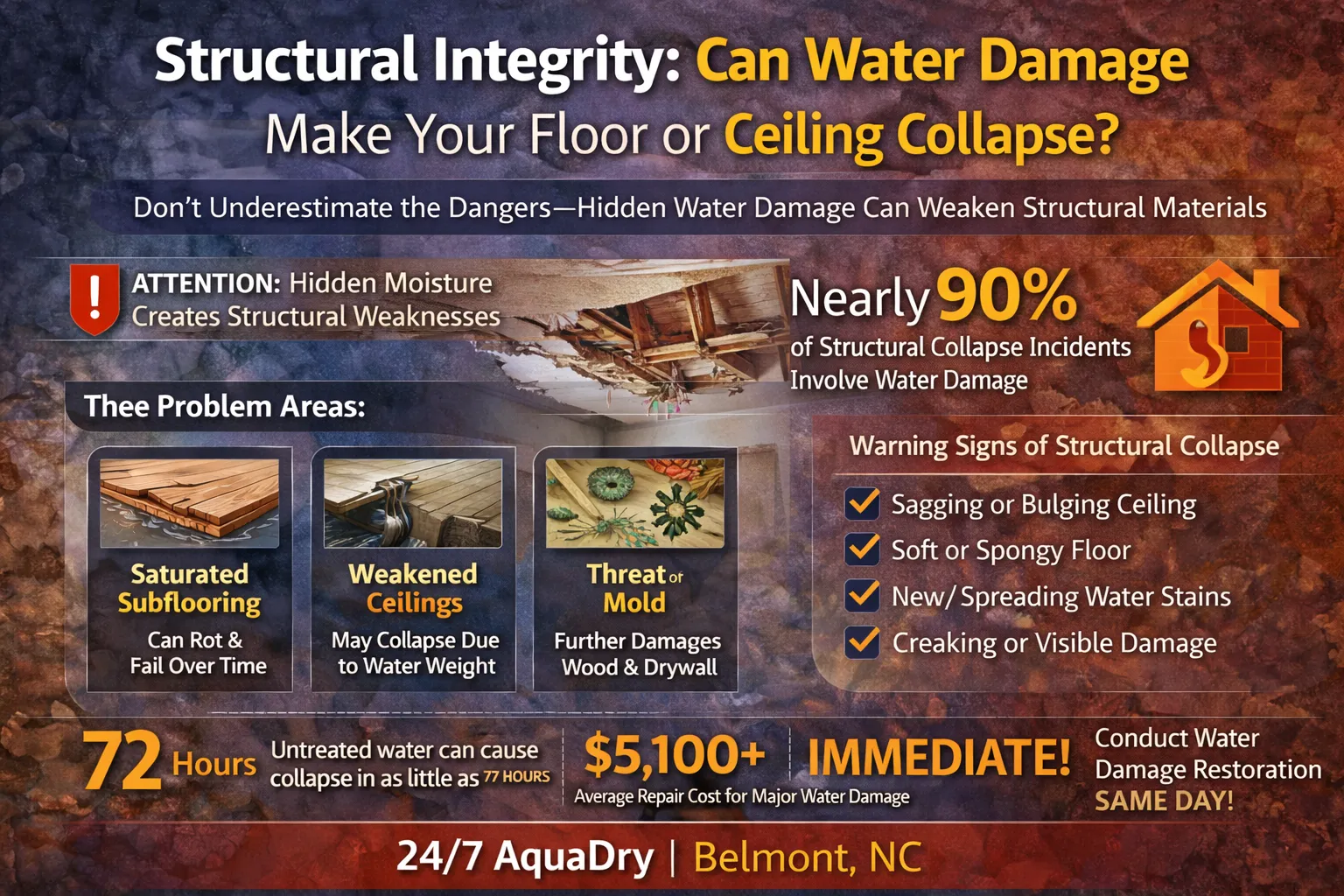
Six, and any one of them means stay out from under it.
Sagging or bulging is the clearest. That is water sitting on top of the board.
A visible dome or bubble means water has pooled. That is the highest-risk version.
Active dripping through the ceiling means the board has already been breached.
Cracks radiating from a stain suggest the board is losing integrity.
A stain that is growing while you watch means water is still arriving.
Creaking or popping sounds from above are worth taking seriously.
If you see any of those, get people and pets out of that room. Move what you can from underneath if you can do it from the edge.
Do not poke it to relieve the pressure unless you know what is above. That is how people end up wearing a ceiling.
Turn off power to any light fitting in that ceiling. Water at a fitting is an electrical hazard as well as a water one.
Do not put a bucket on a table under a bulging ceiling and walk away. If it lets go, the bucket is not the problem.
What Are the Warning Signs of a Failing Floor?
Floors give more warning, and the signs are underfoot.
Soft or spongy spots are the first. That means the subfloor is affected, not just the finish.
A bouncy feel when you walk is the second, and it is more serious. Bounce suggests the joists or their support are involved.
Visible sagging in a floor line is the third. Look along the floor at eye level from a doorway.
New squeaking is the fourth. Moisture changes how boards sit and how fasteners hold.
Gaps opening at skirting, or doors that suddenly stick, can mean the floor has moved.
Cupping hardwood tells you there is moisture underneath. That is not structural yet, and it is a warning.
In a crawl space, look up. Dark staining, damp insulation hanging down, or visible sagging in the joists are all signs.
A wet crawl space is the most common cause of slow floor damage, because it keeps the underside wet indefinitely.
How Long Does It Take for Water to Cause Structural Damage?
Longer than people fear, and shorter than people hope.
Ceiling collapse can happen within hours if enough water is pooling. That is the fast one.
Structural weakening of timber takes much longer. Weeks and months rather than days.
Rot needs sustained moisture over time. It is a slow process and it is why hidden leaks do the most structural harm.
Engineered materials fail faster. Particleboard swells within a day or two of sustained wetting.
The US EPA window of 24 to 48 hours is about mold rather than structure, but it is a useful proxy.
Dry within that window and you have usually avoided both problems. Miss it and both clocks are running.
The house itself matters. A crawl space home in a humid climate dries more slowly than a slab home.
So the honest answer is this. A one-off leak dried quickly rarely causes structural damage.
A leak nobody found for six months often does. That is the whole difference.
It is also why hidden leaks matter more than dramatic ones. The dramatic ones get dealt with the same day.
Is It Safe to Stay in a House With Water-Damaged Floors or Ceilings?
Usually yes, with specific exceptions.
Stay out from under any sagging ceiling. That is a room-level decision, not a house-level one.
Stay off any floor that feels soft or bouncy. Keep weight off it until someone has looked.
Get out of a room where you can hear creaking from above. That is a warning, not a curiosity.
Otherwise most water losses do not make a house unsafe to occupy. They make specific rooms unusable for a while.
The safety question after water damage usually comes down to the type of water rather than the structure.
Contaminated water is a health reason to stay out of a room. A wet floor from a clean supply leak usually is not.
If you are unsure whether something is holding, treat that uncertainty as the answer. Stay off it.
Nobody should have to guess about it. A visit with a moisture meter settles the question in an hour.
If mold has started as well, that is a separate call. Mold removal has its own method and its own containment.
Say early if anyone in the house has asthma or a weak immune system. It changes which rooms get sealed first.
What Should You Do If You See These Warning Signs?
Clear the area first. People and pets out of the room, before anything else.
Stop the water if you can find the source. Local shutoff first, then the main.
Cut power to that area if water is near any electrical fitting. Do not cross water to reach the panel.
Photograph everything before you move anything, including the ceiling or floor from a safe distance.
Move what you can from underneath a sagging ceiling, from the edge of the room rather than under it.
Put a container under an active drip and let it drain rather than trying to plug it.
Do not walk on a floor that feels wrong to test it. That is the most common way people find out the hard way.
Then call someone with a meter. Guessing at structural involvement from the surface is not something anyone should do.
When Does Structural Water Damage Need More Than Drying?
When material has failed rather than simply got wet.
Swollen particleboard subfloor gets replaced. It does not recover its strength.
Delaminated plywood gets replaced. Layers that have separated do not re-bond.
Timber with visible rot gets cut out. Drying stops the rot progressing and does not undo it.
Ceiling drywall that sagged comes down. Even if it dries, the board has deformed.
Anything touched by contaminated water is a different decision entirely. Porous material comes out rather than being dried.
A structural engineer gets involved when joists, beams or load paths are in question. A restoration company should tell you when that line is reached.
Most water losses never get near that. The point of measuring is knowing which kind you have.
Insurance handles the two differently as well. Sudden accidental damage is the straightforward case, and a long-running leak is often treated as maintenance.
That is another reason a slow leak costs more than a dramatic one. It can cost you the claim as well as the repair.
Get the scope in writing either way, split into drying and rebuild. Two numbers are easier to check than one.
We are licensed general contractors in North Carolina and South Carolina and an IICRC Certified Firm, number 56517068, so drying and rebuild sit with the same team.
A sagging ceiling is not something to watch for a few days. It is the one sign on this page that deserves a phone call the same hour.
If a ceiling or floor in your house is showing any of these signs, call us. We handle water damage restoration in Charlotte and across the metro, and a sagging ceiling is a same-day problem.