Is It Safe to Stay in the House After Water Damage?
· Updated August 23, 2026
On this page
Are you trying to find out if it is safe to stay in the house after water damage? You are in the right place. This is one of the first questions people ask us, and they usually ask it while standing in a wet room at a bad hour.
In this article we cover the two things that decide the answer, what clean water means for your family, when a room is truly off limits, how mold changes the picture, and how long it takes before a house is dry again. Keep reading, because the answer is almost never the whole house. It is usually one or two rooms, for a set number of days, and knowing which rooms lets you plan instead of guess.
So Can You Stay in the House After Water Damage?
Most of the time, yes. Most families stay.
The answer turns on two things, and neither one is how bad the room looks. The first is what kind of water it was. The second is how far that water spread.
A clean leak in one room is usually a drying job. A sewage backup is not. Those two situations get very different answers, even if the puddle is the same size.
People get this backwards all the time. A room with two inches of clean water across the floor looks dramatic, and it is often the easier job. A slow toilet leak behind a wall looks like nothing, and it can be the room you have to stay out of.
Size is not the same as risk. What the water carried matters more than how much of it there is.
The second question is spread. Water runs downhill and sideways, and it goes under things. It gets into wall cavities, under cabinets, and through the floor into the room below.
So the real question is not whether your house is safe. It is which rooms are safe, and for how long. That is a smaller question, and it has a real answer.
What Makes a House Unsafe to Stay In After Water Damage?
The water itself is what makes a room unsafe, not the mess.
The S500 standard for water damage restoration sorts water into three types. Every crew in the country uses it. The type decides how the job is run and which rooms you can use.
This is not one company’s opinion. It is the industry standard, published by the IICRC and approved by ANSI. When a crew tells you a room is off limits, they should be able to point at which category it is and why.
That matters for you in a practical way. It means you can ask the question directly. Which category is this water, and what does the standard say we do about it?
The categories are also not fixed forever. Clean water that sits long enough can drop a category on its own. Warmth, time and the material it sits in are what move it.
That is the real reason speed matters. Waiting does not just make the drying longer. It can change what kind of job this is.
Category 1 is clean water
This is water from a clean source. Think of a supply line, a water heater, or a tub left running.
The standard says Category 1 water “does not pose substantial risk from dermal, ingestion or inhalation exposure” and that restorers “may proceed without contamination controls.” In plain terms, it is a wetness problem, not a health problem.
Most burst pipe losses start here. A burst pipe cleanup caught the same day is usually the least disruptive version of this whole situation.
The catch is that clean water does not stay clean forever. Left in the building, it picks things up from carpet, dust and drywall.
Category 2 is water that picked something up
This water was dirty when it arrived, or it sat too long and went bad. Washing machine and dishwasher leaks land here.
The standard says it must be cleaned before drying starts. The crew also wears gear and seals the area.
That extra step is why a Category 2 job takes longer than a Category 1 job of the same size. You are paying for cleaning plus drying, not just drying.
For most families, Category 2 in one room still means you stay in the house. The room gets sealed off and you use the rest of the home normally.
Category 3 is grossly contaminated water
The standard uses that exact phrase. Category 3 water “can contain pathogenic, toxigenic or other harmful agents,” and the examples given include sewage, waste line backflows, and rising water from rivers or streams.
This is the category where rooms come off limits. Not because we are being careful, but because the standard treats that water as a health risk.
Almost everything porous that Category 3 water touched has to go. Carpet, pad, and the lower part of the drywall usually come out rather than get dried.
That sounds severe, and it is the right call. You cannot clean the inside of a carpet pad, and drying dirty water just leaves you with dry dirty material.
Is It Safe to Stay Home After Clean Water Damage?
For a clean water loss in part of the house, staying is usually fine. What changes is daily life, not safety.
The drying equipment is the real disruption. Air movers and dehumidifiers run day and night. They are loud, and they make rooms warm on purpose.
Wet material sometimes has to come out. Carpet pad, baseboard and drywall are the usual ones. That turns part of your home into a work area for a few days.
Speed matters more here than anything else. The US EPA says to dry water-damaged areas and items within 24 to 48 hours, and that “in most cases mold will not grow” if you hit that window.
That window is why equipment goes in the same day, not after the weekend. It is also why crews doing water damage restoration in Charlotte take readings every day.
Dry to the touch is not dry. The meter decides.
A few practical things help while the equipment runs. Keep interior doors open unless a crew asks you to close them, because the air has to move.
Do not turn the machines off at night. They are sized for a set number of hours, and switching them off adds days to the job.
Ask where the moisture readings are being written down. You should be able to see the numbers come down day by day rather than take somebody’s word for it.
When Is It Not Safe to Stay in a House After Water Damage?
A sewage backup is the clearest case. Those rooms get sealed off, cleaned, disinfected, and stay closed until that work is done.
Storm water gets the same treatment, and this is not restoration industry caution. North Carolina’s own public safety guidance says flood water “may contain sewage” and to “keep children and pets out of the affected area until cleanup has been completed.”
So if storm or flood water came through your living space, treat everything it touched as dirty. It does not matter how clear it looked.
There are three other times to stay out of a room, and none of them are about the water. The first is when the power is still on in a wet area.
Water and electricity in the same room is a reason to leave that room until the breaker is off. If the panel itself is wet, that is a call to an electrician, not a decision to make yourself.
The second is a sagging ceiling. If water is sitting above a ceiling and the drywall is bulging or dripping, that ceiling can come down. Stay out from under it.
The third is a gas appliance that got wet. A water heater or furnace that has been standing in water should be checked before it runs again.
Whether you can stay usually comes down to geography
The question is rarely the whole house. It is which rooms got wet, and whether those rooms can be sealed off from the rest.
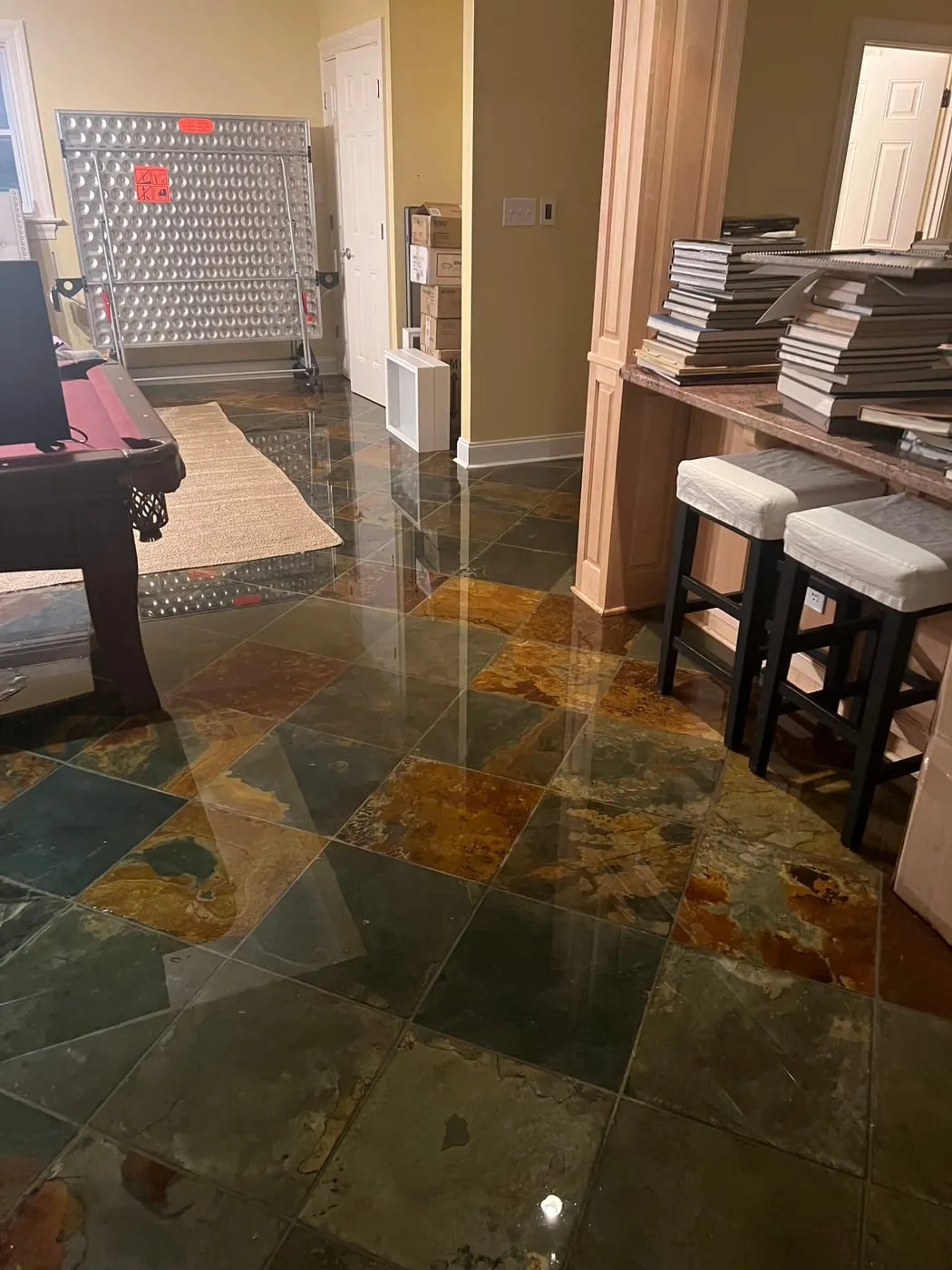
A flooded crawl space usually costs you nothing. You may not even notice the work. Water across your main floor is a different conversation.
Single-story homes on a slab are the hardest case. There is no upstairs to move into, so a large loss on the main floor leaves fewer places to go.
Two-story homes usually give you options. If the loss is downstairs, bedrooms upstairs often stay completely normal.
Is It Safe to Stay in a House With Mold After Water Damage?
This is where people most want a simple yes or no, and where an honest answer has to be conditional.
Prevention is the easy case. Inside that 24 to 48 hour window, drying is the whole job, and there is nothing to remove.
Where mold is already growing, what matters is how much and where. That is exactly what an assessment maps before anyone quotes you.
During mold removal itself, the answer is usually better than people expect. The work area gets sealed before removal starts. That containment is the point of the setup, and life goes on outside it.
How livable that is depends on which room is sealed. A crawl space costs you nothing. A kitchen costs you the kitchen.
The containment is not just a plastic sheet across a doorway. The sealed area is usually held at negative pressure, so air flows into it and not out of it.
That is what keeps the rest of the house normal while the work happens. If you can smell the work from the other side of the barrier, something is wrong and you should say so.
The species of mold does not change the answer
People ask about black mold specifically. The CDC is clear that no test proves a link between it and particular symptoms, and that “all molds should be treated the same with respect to potential health risks and removal.”
So do not wait on a lab result to decide what to do. Find the moisture and fix it.
The CDC does say exposure “may cause a variety of health effects, or none at all.” People with asthma, a mold allergy, a weak immune system or chronic lung disease can have stronger reactions.
If someone in your house is in one of those groups, that is a good reason to move faster. It is also a reason to say so on the first call, because it changes which rooms get sealed first.
The CDC also does not recommend testing your home for mold. If you can see it or smell it, you already know enough to act.
How Long Before It Is Safe to Stay in Your House After Water Damage?
For a clean water loss, equipment usually runs three to five days. The exact number depends on what got wet and how much of it stayed.
Nobody should give you that number before they have taken readings. Anyone who does is guessing.
For dirty water, those rooms open back up once they are cleaned and dried. That is a step in the work, not a date on a calendar.
Several things stretch the timeline, and they are worth knowing up front. Thick material dries slowly, so hardwood, plaster and concrete take longer than carpet and drywall.
Trapped water is the other one. Water inside a wall cavity or under a cabinet has nowhere to go, so those spots often need holes drilled or trim removed to dry at all.
Humid weather slows everything down too. A wet week in the Carolinas means the dehumidifiers work harder for the same result.
The rebuild is a separate clock. Drying might take four days and replacing what came out might take two weeks, and those are two different questions.
Who Decides If It Is Safe to Stay in Your House After Water Damage?
Somebody has to walk the house and measure it. Everything above is the general shape of the answer, and your house is a specific case.
A good first visit checks the wet rooms and the spaces above and below them. Water runs down and sideways. The room that looks wet is rarely the only wet one.
Then you should get a plain answer, room by room. This part of the house is fine. This part is a work area, for this many days.
If the honest answer is that some rooms are off limits for a few days, you should hear that out loud, with the reason. Nobody should learn it from a closed door.
Your insurer does not make this call, and neither does a phone quote. An adjuster decides what gets paid for, which is a different question from which rooms your family can use tonight.
You can ask for the reasoning in writing. A crew that can point at a category, a moisture reading and a standard is telling you something you can check.
What Should You Do If It Is Not Safe to Stay After Water Damage?
Move the people and pets out of the affected rooms first. Not out of the house, out of those rooms.
Take photos before anything gets moved or thrown away. Your insurer will want them, and the damage looks different once a crew has been through.
Photograph the source too, not just the puddle. A picture of the failed supply line or the backed-up drain answers a question the adjuster will ask later.
Shut off the water at the source if you can find the valve. If you cannot, the main shutoff for the house does the same job.
Keep what you throw out, or at least keep a photo of it. Carpet and drywall that came out are part of the claim.
Then call someone who can measure it. We handle water damage restoration in Rock Hill, SC and across the Charlotte metro.
If you are standing in this question right now, call us. A phone call is faster than reading. The answer will be about your house, not houses in general.