Chemical Fires at Home: Causes and How Restoration Helps
· Updated August 23, 2026
On this page
Are you trying to understand what a chemical fire at home involves, and why the cleanup is different? You are in the right place.
In this article we cover what actually causes chemical fires in ordinary houses, why the residue behaves differently from a normal fire, the first hour after one, what restoration involves, and how to store the things most likely to start one. Keep reading, because the mistake people make after a chemical fire is treating the cleanup like any other fire, and that assumption is what makes it worse.
What Causes Chemical Fires at Home?
Ordinary household products, in the wrong combination or the wrong place.
Cleaning products are the most common start. Mixing bleach with ammonia makes a poison gas, and the CDC warns about it by name.
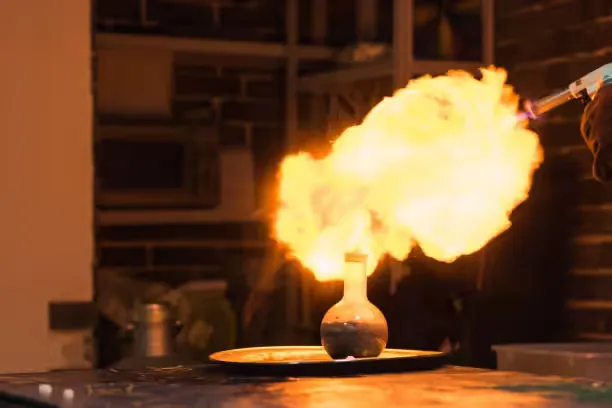
Garages and sheds hold the liquids that burn. Petrol, paint thinner, glue and lighter fluid all give off fumes at room temperature.
Vapor is the part people underestimate. It pools low, travels along a floor, and can reach an ignition source across a room.
That spark is often a water heater or a furnace pilot light. A garage with solvents and a gas appliance in it is the classic setup.
Spray cans are the third group. Stored near heat they can burst, and what is inside usually burns.
Pool chemicals are the fourth, and they catch people out. Some react with water or with each other and make heat on their own.
Oily rags are the fifth, and the least obvious. Rags soaked in linseed oil or some wood stains can heat up alone and catch fire with no flame near them.
Batteries belong on the list too. The NFPA blames lithium-ion fires on damage, overcharging, extreme heat or cold, and faults in the product.
Why Are Chemical Fires More Dangerous Than Ordinary Fires?
Three reasons, and they compound.
The first is speed. Flammable liquids and vapors spread fire faster than ordinary household materials.
The second is what they give off. Burning chemicals make different gases than burning wood or cloth.
The third is what the fire leaves behind. The residue is chemically different, and that changes everything about the cleanup.
Water is the other complication. Water is right for many fires and wrong for others, which is why the fire service asks what was burning.
Some materials react with water. Putting the wrong thing on a chemical fire can spread it or make it worse.
The NFPA is specific about lithium-ion batteries in particular. “Heat, smoke, the release of toxic gases, and the potential for explosions are the dangers associated with lithium-ion battery fires.”
That explosion risk is what makes battery fires their own category rather than a variation on an ordinary one.
For all of these, the advice is the same and it is unsatisfying. Get out, and let the fire service handle it.
A small chemical fire is not the kind you fight with a pan lid. The information you would need to fight it safely is information most people do not have.
What Should You Do Immediately After a Chemical Fire?
Get everyone out first, including pets, and do not go back in.
Call 911 even if the fire looks out. Chemical fires can reignite, and vapor can hang around after visible flames stop.
Tell them what was burning if you know. That single detail changes how they approach it.
Stay upwind and well back. Distance is the only protection you have without equipment.
Once the property is released to you, stay out of the affected rooms until someone can assess them. Residue is on every surface the smoke reached.
Do not start cleaning. This applies to every fire and doubly to this one, because you do not know what the residue is.
Do not run the HVAC system to clear the air. If residue is in the ducts, that spreads it through the house.
Do not put wet or damaged contents into clean rooms. That moves the problem into parts of the house that were fine.
If water was used, it is now in your floors and walls. A wet crawl space under the room is easy to miss and slow to dry.
Photograph everything before anything is moved, including the products involved if they are visible and safe to approach.
Then report the loss to your insurer. Reporting is not the same as committing to a claim.
Why Is Chemical Fire Cleanup Different?
Because the residue is chemically different, and cleaning methods are chosen for the residue.
Soot from a wood fire, a grease fire and a chemical fire behave differently. What lifts one can set another.
That is why identification comes before cleaning on any professional job. Method follows residue.
Some residues are corrosive as well as acidic. Metal fixtures, wiring and appliance housings can suffer within days.
Some react. A general cleaner can set something off instead of cleaning it.
How deep it goes is the other difference. Chemical residue soaks into soft material further than normal soot.
That affects what can be saved. Materials that would be cleanable after a normal fire may need removal after this one.
The air gets more attention too. Sealing the area and filtering it matter more when nobody knows what the residue is.
The honest summary is that this is the fire type where guessing costs the most. It is worth waiting for someone who can identify what they are dealing with.
Test cleaning is normal on a job like this. A crew tries a method on a small hidden patch before doing a whole wall.
That step looks slow and it is not. Getting the method wrong on a full room means paying to refinish it.
Protective equipment is heavier for the same reason. What is safe to breathe is a question, not an assumption.
What Does Chemical Fire Restoration Involve?
The same stages as any fire and smoke damage restoration, with more care at each one.
It starts with assessment and identification. What burnt, what residue it left, and how far it travelled.
Stabilisation follows. If the structure was opened by the fire or the fire service, an emergency board-up closes it.
Water comes next, because putting out a fire uses water. The US EPA window of 24 to 48 hours to dry water-damaged areas applies from the day of the fire.
Containment and air filtration go up before cleaning starts. That keeps residue out of rooms that were unaffected.
Then cleaning, surface by surface, dry methods before wet ones, with products chosen for the residue.
Then odor treatment as a separate stage, then sealing on surfaces that cannot be fully cleaned.
Belongings are handled on their own and listed as they go. Some things clean up and some do not, and the sorting is part of the job.
The HVAC system gets its own inspection. If it ran during the fire, it carried residue everywhere the ducts go.
Can You Stay in the House After a Chemical Fire?
Sometimes, and the answer depends on how far the smoke went.
Smoke travels much further than fire. A contained garage fire can leave residue through a whole house.
Stay out of the affected rooms until someone who can assess them says otherwise. That is different from leaving the property.
Whether the rest stays usable depends on layout. Rooms that can be sealed off from the affected area are usually fine.
An attached garage is the awkward case. It shares walls and often shares air with the house.
Watch for specific warnings. Persistent smell, headaches or irritation that improve when you leave are worth taking seriously.
The CDC’s framing on airborne irritants applies here. Reactions are stronger for people with asthma, a mold allergy, a weak immune system or chronic lung disease.
If someone in the house is in one of those groups, say so on the first call. It changes which rooms get sealed first.
If in doubt, stay elsewhere for a night. That is a cheap decision compared with the alternative.
How Do You Prevent Chemical Fires at Home?
Storage does most of the work.
Keep flammable liquids in their original containers, tightly closed. The label tells the fire service what they are dealing with.
Keep them away from heat, and well away from water heaters and furnaces. The fumes travel to the pilot light, not the other way round.
Never mix cleaning products. Bleach with ammonia is the well-known one, and it is not the only one.
Open a window when you use solvents, paint or strong cleaners. Do not work in a closed room.
Lay oily rags flat outdoors to dry, or seal them in a metal container with a lid. Do not leave them balled up in a bin.
Store pool chemicals separately from everything else, dry and cool, and never together in one tub.
Charge devices on a hard surface, away from bedding and away from the way out. The NFPA says to stop using a battery that swells, smells odd, gets very hot or changes color.
Keep an extinguisher rated for the hazards you actually store, and know where it is before you need it.
Check the smoke alarms monthly. In a garage or workshop, a heat alarm may suit better than a smoke alarm.
Keep the garage tidy enough to reach the shutoffs. Fuel stacked in front of a gas valve is a problem you only notice once.
Do not decant chemicals into drink bottles. It is a poisoning risk as well as a fire one, and it hides what the fire service is facing.
Why Does a Chemical Fire Need a Professional Restoration Company?
Because the first decision in the cleanup is a diagnosis, and getting it wrong is expensive.
Identifying the residue decides the method. That is not something to guess at with a supermarket cleaner.
Wiping unknown residue can drive it into the surface, turning a cleanable film into a permanent stain.
It can also expose you to something you cannot identify. Without proper equipment there is no way to know what is airborne.
There is a paperwork reason too. A chemical fire claim needs a clear record of what burnt and what it reached.
Photographs, residue mapping, moisture readings and a contents inventory are what a claim is decided on.
Water is the other half of it, and it gets forgotten. Fires are put out with water, and water damage restoration runs on the same clock as the fire work.
Check credentials you can verify. We are an IICRC Certified Firm, number 56517068, and licensed general contractors in North Carolina and South Carolina.
We are family-owned and have worked this metro since 2014. If you have had a chemical fire, call us, and we cover fire damage restoration in Charlotte and across the region.