Will Filing a Water Damage Claim Raise My Insurance Rates?
· Updated August 23, 2026
On this page
Are you wondering whether filing a water damage claim will raise your insurance rates? You are in the right place. It is one of the most common reasons people wait before calling anyone, and one of the least answered honestly.
In this article we cover what really happens when you file, the shared database your claim goes into, how many years it follows the house, and how to tell whether your loss is even worth claiming. Keep reading, because the worst version of this decision is making it blind. Most people who regret their choice made it before anyone measured the damage.
Will Filing a Water Damage Claim Raise Your Insurance Rates?
It can. It is not automatic.
The Texas Department of Insurance is one of the plainer-spoken state regulators on this. It says insurance companies look at a property’s past claims and use them as a factor in deciding what you pay for homeowners insurance.
Read that word carefully. A factor. Not a switch that flips every time, and not something that never happens either.
Whether one water damage claim moves your premium depends on things no article can know. Your carrier matters, and so does your claim history.
The size of the loss matters too, along with the rules in your state.
Anyone who tells you flatly that filing always raises your rates is guessing. So is anyone who tells you one claim never matters.
What you can do is find out. Your agent knows how your carrier treats a first water claim, and that is a five-minute phone call.
Ask that question with a real number in hand. The number is what changes the answer, and getting it is the part most people skip.
What Happens to Your Rates When You File a Water Damage Claim?
Filing does not stay a private matter between you and your carrier.
Most homeowners insurance companies report claims to a shared database. It is called the Comprehensive Loss Underwriting Exchange, better known as CLUE, and it is run by LexisNexis.
According to the Insurance Information Institute, that report records the type of loss on the home, the date of the loss, and the amount and status of each claim. Insurers generally use it when they underwrite policies.
That reframes the question. It is not only about what your current carrier does with this claim.
The claim becomes part of the property’s record. A future insurer quoting your renewal can see it. So can one quoting the next owner of your house.
This is also why small claims can be a poor trade. A claim close to your deductible pays you very little and still goes on the record.
You are entitled to see your own report. LexisNexis provides one free copy a year.
If you are curious what your property’s history already looks like, request it. It costs nothing and takes the guesswork out.
How Long Does a Water Damage Claim Affect Your Insurance?
Here the authorities themselves differ, which tells you how fuzzy the edges are.
The Insurance Information Institute describes loss history reports as going back five years. The Texas Department of Insurance says a CLUE report shows claims for the past seven.
In practice, plan on a claim being visible for five to seven years. Treat anyone quoting one precise universal number with suspicion.
That range matters more than it sounds. A claim you file this year can still be sitting on the report when you sell the house.
It also means the decision is not just about this year’s premium. It is about the property’s record for the better part of a decade.
None of that means do not file. Insurance exists to be used, and a large loss is exactly what it is for.
It means the size of the loss should drive the decision. A five-figure loss is what a policy is for. A loss barely over the deductible usually is not.
Is This Water Damage Claim Big Enough to Be Worth Filing?
Most people asking about rates are really asking something narrower. They want to know whether this loss is big enough to justify a claim.
That is a fair question. But look at what you need in order to answer it.
You need the actual size of the loss. Not a glance at a wet floor.
Water damage is routinely bigger than it looks. Water travels under flooring, into wall cavities, and down into the room below.
It is also sometimes smaller than it feels at two in the morning. Standing water across a tile floor can look like a disaster and dry out in three days.
The gap between how it looks and what it costs is the whole problem. You cannot price a loss by looking at it, and neither can anyone else over the phone.
That is why water damage restoration starts with measuring rather than quoting. Moisture readings tell you which materials are wet and which only look wet.
The deductible is the line that matters
Your deductible is the number to compare against, not the total damage.
If the loss comes in at or near your deductible, filing buys you almost nothing. You still carry the claim on the record for years.
If the loss is well above it, the calculation flips. Paying five figures out of pocket to protect a premium is rarely the better trade.
The awkward middle is real, and it is where the measurement earns its keep. A loss that looks like it might be near the line is exactly the one you should not guess at.
Should You Get the Damage Measured Before You File a Water Damage Claim?
Yes, and this is the part that changes outcomes.
You do not have to decide about the claim before anyone looks at the damage. Those are two separate steps, and most people collapse them into one.
Deciding first, with no numbers, is how people end up on both bad paths. Some file a claim that turned out to be barely above the deductible.
Others eat a five-figure loss out of pocket because it did not seem that bad. Then the flooring cups a month later and the real number arrives too late to claim.
A proper first visit gives you the number before you commit to anything. Nobody is asking you to file while the crew is still in the driveway.
Getting the damage assessed does not start a claim. It gives you the information to decide whether to start one.
Speed still matters for the building, though, and that is a separate clock. Drying should begin quickly whether or not you file.
The two decisions run in parallel. Dry the house now, decide on the claim once you know the size.
What Does a Restoration Company Actually Do About Your Claim?
We are a restoration company, not an insurance advisor, and that line matters.
What we do is build the record you decide with. That record is useful to you whichever way you go.
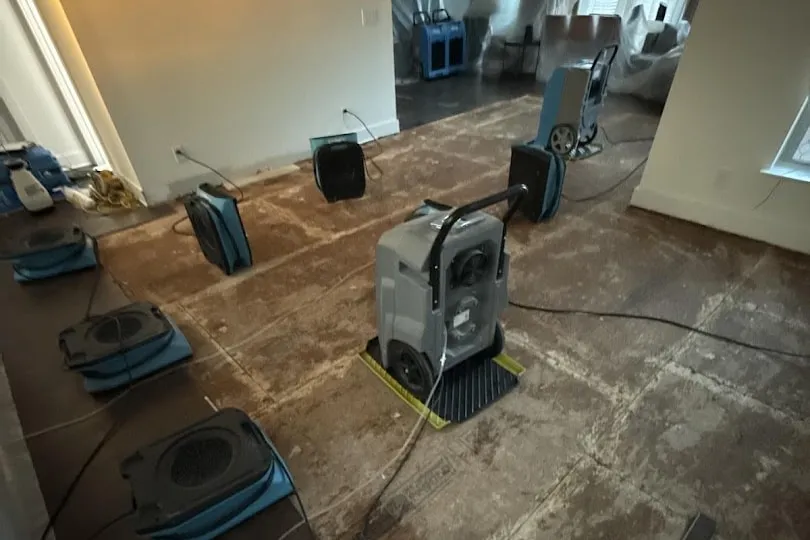
From the first visit, the loss gets documented the way a claim would need it. Photographs, moisture readings taken point by point, and a drying log.
The log shows the same points measured on every visit until they reach dry standard. That is evidence, not an opinion about how it went.
If you file, that documentation is what the claim runs on. Adjusters work from records, and a record built as the job happened beats one reconstructed afterwards.
If you do not file, it is still an honest scope of what happened to the building. You paid nothing to have the facts.
When you do file, we work with your adjuster. In most cases we bill your carrier directly for the restoration work.
Our insurance claims process covers how that runs, including the carriers where the money goes to the homeowner instead. That is worth knowing before you assume how it will work.
Documentation is worth more than argument
Claims are decided on evidence, not on how strongly anyone feels about the damage.
A moisture reading taken on day one and day four is a fact. “It looked really wet” is not.
That is why the readings start on the first visit rather than when someone asks for them. Reconstructing a scope after the drying is done leaves gaps a carrier can question.
It also protects you against the opposite problem. A documented scope stops a job from growing beyond what actually got wet.
Who Can Tell You How a Water Damage Claim Will Affect Your Rates?
Three people can help, and none of them is a restoration company.
Your agent is the fastest. They know your carrier’s actual practice on a first water claim and can usually answer in one call.
Your carrier’s claims line is the second. They can tell you what filing does and does not commit you to.
Your state’s Department of Insurance is the third, and it is the one people forget. Both North Carolina and South Carolina run consumer help lines for exactly these questions.
What we can tell you is the size of the loss. That is the input all three of those conversations need.
Get the number first, then make the calls. It turns a vague worry into a decision with an answer.
Be direct when you ask. “How does a first water damage claim affect my premium with this carrier” gets a better answer than “will my rates go up”.
What Should You Do Before You File a Water Damage Claim?
Stop the water first. Everything else can wait ten minutes.
Photograph the damage before anything is moved or thrown away. Get the source too, not just the puddle.
A picture of the failed burst pipe or the backed-up drain answers a question the adjuster will ask later. Damage photos alone rarely do.
Then get the loss measured. That is the number your whole decision rests on, and it is the one thing you cannot estimate from a doorway.
Keep receipts for anything you buy or pay for in the meantime. Emergency mitigation costs are often part of the claim.
Do not throw out the wet material until someone has seen it or you have photographed it. Carpet and drywall that came out are part of the scope.
If mold has already started, say so on the first call. Coverage for mold removal usually depends on it resulting from a covered water loss, so how it is documented matters.
Then have the rates conversation with your agent, with the real number in hand. That is the order that leaves you with no regrets either way.
If you are standing in this decision right now, call us. We handle water damage restoration across Charlotte, and we will start with the measuring rather than the paperwork.