Water Mitigation vs. Water Remediation: What's the Difference?
· Updated August 23, 2026
On this page
Are you trying to work out the difference between water mitigation and water remediation? You are in the right place, and the distinction is not just industry vocabulary.
In this article we cover what each word actually means, which one happens first, how the difference shows up on your invoice and your insurance claim, and why a quote that mixes them together is hard to check. Keep reading, because most people meet these two words on an estimate and assume they are synonyms. They are not, and the gap between them is where the money is.
What Is the Difference Between Water Mitigation and Water Remediation?
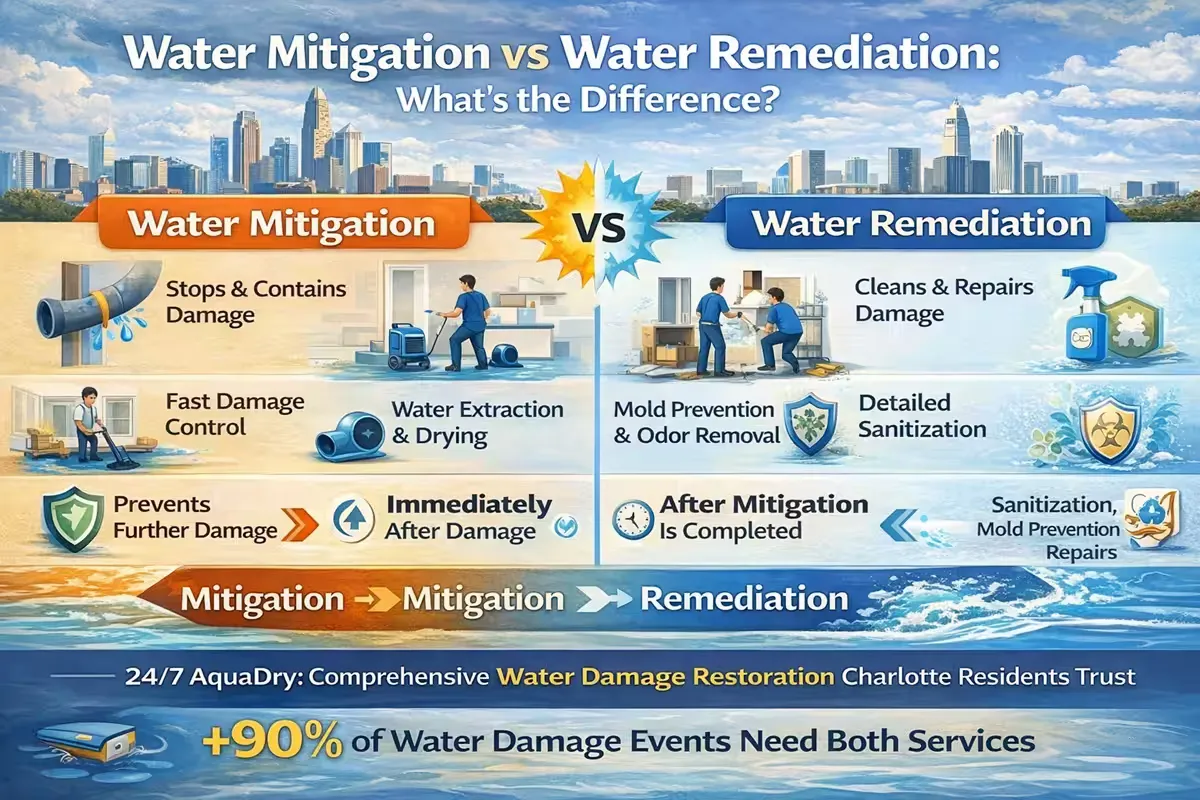
Mitigation stops the damage getting worse. Remediation deals with what the water caused.
Mitigation is the emergency phase. Stop the water, extract it, dry the structure, prevent secondary damage.
Its whole purpose is limiting the loss. Every hour it happens sooner, the loss is smaller.
Remediation comes after, and it deals with what the water left behind. Taking out ruined material, cleaning it up, and making the space safe again.
Then reconstruction is a third thing entirely. Putting the building back is a build phase, not a restoration one.
So the sequence is mitigate, remediate, rebuild. Most jobs need the first and third, and only some need the second.
The confusion is understandable because the words get used loosely. Plenty of companies say remediation when they mean the whole job.
The difference matters because they are priced, timed and insured in different ways. That is the useful reason to know which is which.
What Does Water Mitigation Actually Involve?
Everything aimed at stopping the loss growing.
Stopping the source is first. A shutoff valve, a plumber, or a tarp over a hole in the roof.
Extraction is second. Standing water gets pumped or vacuumed out, because removing it as a liquid is far faster than evaporating it.
Then the structure gets dried. Air movers move air across wet surfaces and dehumidifiers pull the water out of the air.
Moisture readings run throughout. They are how anyone knows whether the drying is working.
Material decisions happen here too. What can be dried in place and what has to come out for the rest to dry.
Contents get moved out of harm’s way, and blocks go under furniture legs so finishes do not bleed into flooring.
Speed is the defining feature of this phase. The US EPA says to dry water-damaged areas within 24 to 48 hours, and that “in most cases mold will not grow” if you do.
Good mitigation is what stops remediation being needed at all. That is the clearest argument for calling on day one.
Blocking and padding sits in this phase too. Wooden blocks under furniture legs stop finishes bleeding into wet carpet.
So does protecting what is still dry. Sealing a doorway keeps a one-room loss from becoming a two-room one.
None of that looks dramatic on an invoice. It is the difference between losing one room and losing three.
What Does Water Remediation Actually Involve?
Dealing with contamination, which mitigation alone does not address.
If the water was dirty, remediation is not optional. Cleaning has to happen before drying can even start.
If mold has grown, remediation is the job. Containment, negative air, removal of affected material, cleaning and verification.
Containment goes up first. The work area gets sealed so removal does not spread spores through the house.
That area is usually held under negative pressure, so air flows into it rather than out.
Affected porous material comes out rather than being cleaned. You cannot clean the inside of insulation or carpet pad.
Then cleaning and sanitizing of what remains, followed by correcting the moisture source.
That last step decides whether the work lasted. Cleaning without fixing the water buys you a season.
Verification is sometimes part of it. Where pre- and post-testing is agreed at the start, an independent lab confirms the cleared area passed.
That is worth agreeing up front rather than asking for later. Testing after the fact tells you much less.
Mold removal is the most common kind of remediation on a water job. A sewage backup is the other.
Which Comes First, Mitigation or Remediation?
Mitigation, almost always, and the order is not negotiable.
You cannot remediate a building that is still taking on water. The first job is always making it stop.
Extraction and drying follow immediately. Those are mitigation, and they are what keep the remediation phase small.
Remediation only comes in if the water was dirty, or if drying started too late.
There is one exception. Dirty water has to be cleaned up before drying starts, so cleaning comes first there.
That is still mitigation in purpose. It is stopping the loss growing, just with an extra stage.
Reconstruction always comes last. Nothing gets rebuilt until the structure has reached dry standard.
Building over a wet cavity is the most expensive mistake on this whole list. It hides the problem behind new drywall.
How Does the Difference Show Up on Your Bill?
As separate line items, and that is what makes an estimate checkable.
Mitigation is usually billed by equipment and time. Number of air movers, number of dehumidifiers, days on site, and the extraction work.
Those are countable. You can look at a room and see how many machines are in it.
Remediation is billed by scope. How much area is sealed off, what came out, the cleaning and the disposal.
Rebuild is a build cost. Drywall, floors, trim, cabinets and paint, priced like any other building job.
A quote that merges all three into one number is very hard to check. You cannot tell what you are paying for.
Ask for the phases separated. Mitigation, remediation if any, and rebuild.
That also tells you whether remediation is even in the scope. Some jobs genuinely do not need it.
If remediation appears on a quote for a clean water loss caught on day one, ask why. It may be justified, and it is a fair question.
How Does Insurance Treat Mitigation and Remediation Differently?
Quite differently, and this catches people out.
Mitigation is usually the least contentious part of a claim. Most policies require you to take reasonable steps to prevent further damage.
So emergency drying normally proceeds without waiting for approval. Insurers expect you to act and document as you go.
Remediation is where it gets fussier, mold most of all. Cover usually depends on the mold coming from a covered water loss, and on you acting fast.
Mold that grew because a loss went unreported is much harder to claim. The delay can cost you the coverage as well as the work.
The rebuild usually needs sign-off before it starts. That sits between the phases and adds time.
This is why the paperwork from the drying phase matters so much. Readings, photographs and equipment logs are the proof.
A reading taken on day one and day four is a fact. “It looked really wet” is not.
Our insurance claims process covers how the billing usually runs, including the carriers where payment goes to the homeowner rather than to us.
Why Does This Distinction Actually Matter to You?
Three practical reasons, beyond getting the vocabulary right.
The first is speed. If you know mitigation is the phase that shrinks the loss, you understand why day one matters more than day three.
The second is checking the quote. Knowing which phase you are being priced for lets you ask better questions.
The third is knowing when to push back. Remediation on a clean, quickly-caught loss deserves an explanation.
There is a fourth if you are comparing quotes. Two can look wildly different because one includes the rebuild and the other does not.
That is not necessarily dishonesty. It is often two companies answering different questions.
Ask both for the same three phases and the numbers become comparable.
It also helps with timelines.
Drying is days. Remediation is days to weeks. The rebuild can be weeks to months.
One number for all of that is a guess dressed as an answer.
What Happens If Mitigation Is Done Badly?
The building looks dry and is not, and every following phase inherits the problem.
Trapped moisture in a wall cavity is the usual failure. Nothing on the surface shows it.
Then mold grows behind new drywall. That is a remediation job that only exists because the mitigation was incomplete.
Flooring is the other common casualty. Hardwood laid over a damp subfloor cups and has to come up again.
Smell is the early warning. A musty room weeks after a supposedly finished job means something stayed wet.
The way to avoid all of it is the readings log. Equipment comes out because the numbers say dry, not because it is day four.
Ask to see it during the job rather than at the end. You should be able to watch the figures fall.
If nobody is measuring, nobody knows. That is the difference between real drying and a few fans in a room.
Ask what dry standard means on your job. It is a comparison against unaffected material in the same house, not a fixed number.
Ask what happens if a reading stalls. A material that stops drying usually means trapped water and needs opening up.
If you are looking at a quote that does not distinguish these phases, get in touch and we will walk through it with you.
Who Handles Mitigation and Remediation on a Water Loss?
Often the same company, and there are advantages to that.
One crew doing both does not lose what it learned. The people who measured the water know where it went.
A handover mid-job is where scope tends to go wrong. The second company starts from a description rather than from readings.
It matters more when the water was dirty. Whoever pumped it out knows what got wet and for how long.
The rebuild is sometimes a separate trade, and that is normal. Ask up front who is doing it.
What you want to avoid is discovering halfway through that nobody owns the next phase.
We handle mitigation, remediation and the rebuild, and we are an IICRC Certified Firm, number 56517068, licensed as general contractors in North Carolina and South Carolina.
We are family-owned and have worked this metro since 2014, so the crew that arrives is not a subcontractor you have never met.
Ask who signs off that the structure is dry before the rebuild starts. That handover is where problems get built into a wall.
If water is in the house now, that is a mitigation question and it is urgent. Call us, and we cover water damage restoration in Charlotte and the wider metro.