The Emergency Board-Up Process: What Homeowners Can Expect
· Updated August 23, 2026
On this page
Are you trying to find out what happens during an emergency board-up? You are in the right place, and it is a shorter process than most people expect.
In this article we cover what a board-up actually is, the situations that call for one, what a crew does step by step, how long it takes, how insurance usually treats it, and why doing it yourself often costs more than it saves. Keep reading, because a board-up is the one job on a damaged property where a few hours genuinely changes the outcome.
What Is an Emergency Board-Up?
It is the work of closing a building that has been opened.
After a fire, a storm or a break-in, a property often has holes in it. Broken windows, a forced door, a hole in the roof, a wall opened by the fire service.
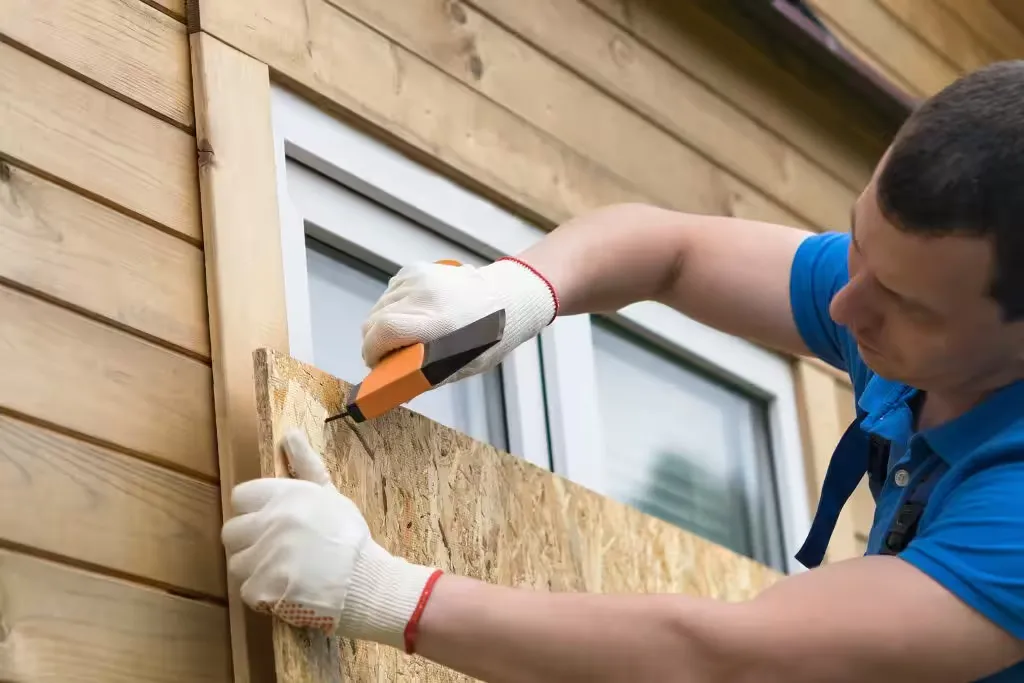
A board-up seals those openings. Plywood over windows and doors, tarps over roof damage, and secure panels where a wall is missing.
The point is not appearance. It is keeping weather, animals and people out of a building that cannot keep them out on its own.
It is meant to be temporary. None of it is a repair, and none of it is built to last.
It buys time for everything else. The claim, the scope of work and the rebuild all take longer than the building can safely stay open.
It is also usually the first job on site. Nothing else sensibly starts while the building is still exposed.
That order matters more than it sounds. Cleaning a room that is about to take rain through the ceiling is wasted work.
When Do You Need an Emergency Board-Up?
Any time the building envelope is broken and cannot be closed properly the same day.
After a fire is the most common. Fires break windows, and the fire service often has to cut into a roof or a wall to reach the fire.
After a break-in is the second. A forced door or a smashed window leaves the property open until a real repair happens.
After a storm is the third. Wind damage to a roof, a fallen tree through a wall, or a window taken out by debris.
After vandalism, and after a vehicle hits a building, both qualify.
There is a fourth situation people do not think about. A vacant property awaiting demolition or renovation gets boarded to stop unauthorised entry.
The test is simple. If someone could walk in, or rain could get in, the building needs closing.
Speed matters because the risks stack. An open building takes weather, invites entry, and can void parts of an insurance claim.
If the fire service has told you the property is unsafe to occupy, assume you need a board-up. They usually say so directly.
Commercial buildings have an extra reason. An open shop or office is a liability question as well as a security one.
Vacant homes are the other case. A property nobody is living in gets found quickly once it is open.
Even a small opening counts. A single broken pane at the back of a house is enough for weather and for entry.
What Happens During the Emergency Board-Up Process?
It starts with an assessment, not a stack of plywood.
The crew walks the property and identifies every opening. Windows, doors, roof, walls, and anything a person could climb through.
Safety gets checked first. Boarding a wall that is not sound puts the crew at risk and does nothing for the building.
Then the roof, because that is where water comes in. Tarps get fitted over damaged sections and secured against wind.
A tarp that lifts in the first storm is worse than none, so how it is fastened matters more than the tarp itself.
Windows and doors come next. Plywood is cut to fit and fastened to the frame or through-bolted where the frame is gone.
Doors you still need are handled another way. A locking temporary door lets you and the crew in without leaving the place open.
Utilities get sorted where they matter. Power, gas and water may need shutting off, and that is agreed rather than assumed.
Everything gets photographed before and after. That record matters for the insurance claim as much as the work does.
Debris gets cleared from the openings first. Broken glass and burnt material in a window frame stop plywood sitting flat.
Fixings are chosen for the material, not for speed. Screws into a burnt frame do not hold, so those openings get through-bolted or braced instead.
Ventilation is considered where it matters. Sealing a smoke-damaged building completely can trap residue and moisture inside it.
How Long Does an Emergency Board-Up Take?
Usually hours rather than days.
A single broken window or a forced door can be an hour or two. That includes travel, assessment and the work itself.
A house-sized fire with multiple openings and roof damage is a half day to a full day.
A large commercial property takes longer, mostly because there is more of it and more to make safe.
How fast someone arrives matters more than how long the work takes. The board-up is quick. Getting a crew there is the part that varies.
That is why board-up is a 24-hour service rather than a scheduled one. Weather does not wait for business hours.
We answer the line at any hour, and on a dispatched emergency we are at your door within 60 minutes.
The temporary work stays in place until the real repair happens. That can be days or weeks depending on the claim.
Tarps and boards should be checked periodically over that time. Weather works on them, and a failed tarp puts you back where you started.
Ask who is responsible for those checks. On a long claim it is easy for everyone to assume it is somebody else’s job.
Wind is the usual failure. A tarp that was fitted in still air behaves differently in a storm three weeks later.
If a board or tarp does fail, report it and photograph it. Additional damage after a failed mitigation is treated differently from the original loss.
Does Insurance Cover Emergency Board-Up?
Usually, and there is a specific reason it does.
Most policies ask you to take reasonable steps to stop further damage after a loss. Boarding up an open building is the clearest example there is.
So a board-up is often not just covered, it is expected. Failing to do it can affect the rest of the claim.
If rain gets into an unboarded house for three days, an insurer may treat that additional damage differently from the original loss.
Report the loss as soon as the property is safe. Reporting is not the same as committing to a claim.
Keep every receipt and every photograph. Emergency mitigation costs are usually claimable, and the record is what they are paid on.
Ask about additional living expenses if the property is unliveable. That is worth asking early rather than discovering later.
Our insurance claims process covers how billing usually runs, including the carriers where the payment goes to the homeowner rather than to us.
Do not delay the board-up waiting for approval. Emergency mitigation is the category insurers expect you to act on first and document as you go.
Can You Board Up a Property Yourself?
Sometimes, and it is worth being honest about when.
A single ground-floor window with a sound frame is within reach of most people. Plywood, screws and an hour.
Beyond that, the reasons to stop stack up quickly.
A fire-damaged building may not be structurally sound. Walls, floors and roofs that have been through a fire and then soaked with water are not predictable.
Roof work is the clearest line. Tarping a damaged roof means working at height on a surface that may have burnt or rotten decking.
There is also the soot. It settles on every surface the smoke reached, and without the right mask there is no way to know what you are breathing.
A poorly fitted board is also a false sense of security. Plywood screwed to a burnt frame comes off in the first storm or the first attempt at entry.
Insurance is the last reason. Work done by a company is photographed, invoiced and easy to claim.
If you do board a window yourself, photograph it and keep the receipt. That is still mitigation and it still counts.
What Happens After the Emergency Board-Up?
The board-up is step one, and it makes the rest possible.
An assessment follows. How far did the fire, smoke or water actually go, and what needs to happen.
If there was a fire, water almost certainly followed it. Putting a fire out uses water, and that water is now in the floors and walls.
The US EPA says to dry water-damaged areas within 24 to 48 hours, and that in most cases mold will not grow if you do.
So drying starts alongside everything else, not after it. That clock runs from the day of the loss.
Then the fire and smoke restoration work, in stages: stabilise, clean, treat odor, seal, rebuild.
Contents get handled separately and inventoried, often off site.
The temporary work comes off when the permanent repair goes in. That is the end of the board-up’s job.
Ask who is doing the rebuild at the start. A company that mitigates and rebuilds saves you handing the job over halfway.
How Do You Choose a Company for an Emergency Board-Up?
Response time first. A board-up next week is a different service from a board-up tonight.
Ask whether they answer the phone at night. Fires and break-ins do not happen at convenient hours.
Ask whether they handle what comes next. A board-up crew that cannot do the water damage restoration or the smoke work means a handover mid-crisis.
Ask how they document. Photographs before and after, and an itemised invoice, are what the insurance claim runs on.
Ask about the roof specifically. Tarping is the part most likely to be done badly, and a failed tarp undoes everything.
Check credentials you can verify. We are licensed general contractors in North Carolina and South Carolina, and an IICRC Certified Firm, number 56517068.
Ask what happens if the temporary work fails before the repair. Weather works on tarps and boards, and someone should be checking them.
We are family-owned and have worked this metro since 2014, which means the crew coming out is not a subcontractor you have never heard of.
Ask whether the quote is itemised. A single lump sum is harder to claim than a list of openings and materials.
Ask what the board-up does not cover. Knowing that up front stops an argument later about who was meant to check the roof.
If your property is open right now, that is the urgent part. Call us, and we handle emergency board-up and everything after it across Charlotte and the surrounding metro.