From Burst Pipe to Dry Home: Water Extraction Techniques Explained
· Updated August 23, 2026
On this page
Are you trying to understand how water extraction actually works after a burst pipe? You are in the right place, and the equipment is more specific than most people imagine.
In this article we cover why extraction comes before drying, the machines that do each job, how crews find water they cannot see, what dry standard actually means, and why a shop vac and a box fan cannot get there. Keep reading, because the difference between a professional dry-out and a home one is not effort. It is measurement.
Why Does Water Extraction Come Before Drying?
Because evaporating water is slow and pumping it is fast.
Every gallon left on the floor has to leave the building somehow. Extraction removes it as a liquid, which takes minutes.
Drying removes it as a vapor, which takes days. The two are not interchangeable.
So the first job on any wet building is getting the bulk water out. That is not a preliminary step, it is most of the work by volume.
It also protects material. Standing water keeps soaking into carpet pad, subfloor and drywall for as long as it sits.
Every hour of standing water is more material moving from salvageable to removable.
There is a clock on top of that. The US EPA says to dry water-damaged areas within 24 to 48 hours, and that “in most cases mold will not grow” if you do.
You cannot hit that window while there is still water on the floor. Extraction is what makes the window reachable.
What Equipment Is Used for Water Extraction?
Different machines for different volumes, and choosing wrong wastes hours.
Truck-mounted extractors handle the largest volumes. The pump and vacuum sit in the vehicle, so power and capacity are not limited by what fits through a door.
Portable extractors are the workhorse for most house losses. They fit in a crawl space or up a flight of stairs where a hose run would not reach.
Submersible pumps handle standing water deep enough to pump. A flooded basement or crawl space is the usual case.
Weighted extraction tools are the ones people have never heard of. The operator stands on a head that presses the carpet while vacuuming it.
That pressure matters. Water in the pad below the carpet does not come out without compression.
Wands and hard-surface tools deal with tile, vinyl and hardwood. Different heads for different surfaces.
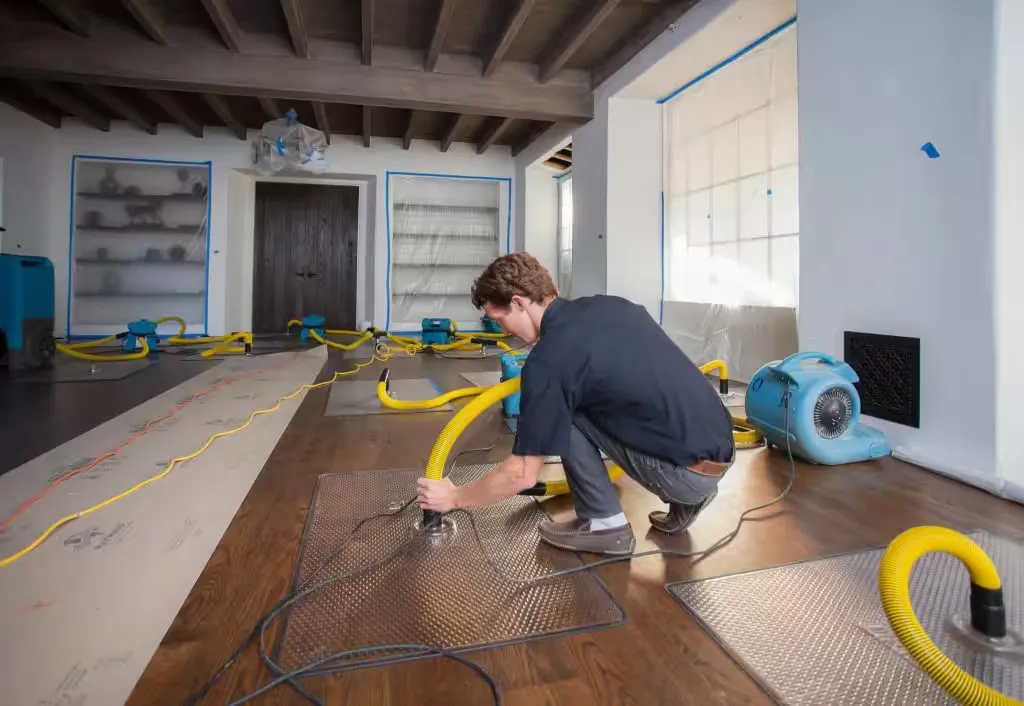
Then air movers and dehumidifiers take over, and those are drying equipment rather than extraction equipment.
A shop vac is fine for a small clean spill. It has no compression, limited capacity and no way of telling you when the pad is empty.
How Do Crews Find Water They Cannot See?
By measuring, because you cannot judge hidden water by looking at a room.
Moisture meters are the core tool. A pin meter reads inside the material and a pinless one scans behind a surface without marking it.
Readings get taken across a grid, not just where the floor looks wet. That is how you find the edge of the water.
Thermal cameras help find where to look. Evaporating water cools a surface, so wet areas often show as cooler.
A camera does not measure moisture, though. It shows a temperature difference, and a meter gives you the number.
Hygrometers read the air rather than the material. Temperature and humidity in the room tell you whether the dehumidifiers are keeping up.
The spaces above and below get checked as a matter of course. Water runs down, so the ceiling under a wet room is often the second casualty.
Wall cavities get checked at the base. Water wicks upward through drywall, so the bottom few inches tell you what is inside.
The space under the floor gets the same treatment. A crawl space can hold water for weeks and feed moisture into the room above.
Insulation gets checked rather than assumed. It is the material most likely to be soaked and least likely to show it.
That mapping is the part a home dry-out cannot replicate. Not because the equipment is exotic, but because nobody has it in a cupboard.
What Is Structural Drying and How Does It Work?
Drying a building is a controlled process with four variables.
Airflow is the first. Air movers push air across wet surfaces to carry away the saturated layer sitting on them.
Without that airflow, evaporation slows to almost nothing. It is why fans point at surfaces rather than into the room.
Humidity is the second. Dehumidifiers pull water out of the room air so the air can accept more from the materials.
Fans alone just move damp air around. Both machines together are what actually dries a structure.
Temperature is the third. Warmer air holds more moisture, which is why drying rooms are kept warm on purpose.
Time is the fourth, and it is the one nobody can shorten past a point. Dense materials release water slowly whatever you do.
Equipment placement is deliberate rather than approximate. Air movers go at an angle so air sweeps along a surface instead of hitting it head on.
That is why moving the machines yourself sets the job back. So does switching them off at night, because cool material re-absorbs what evaporated during the day.
When Do Materials Have to Come Out Instead of Drying?
When they cannot dry in place, or cannot dry fast enough to matter.
Carpet pad is the usual first casualty. It holds water, dries slowly and costs little to replace.
Carpet itself can often be saved on a clean water loss if extraction happens quickly.
Drywall depends on how high the water wicked and how long it sat. Cutting the bottom section is often faster than trying to dry a whole wall.
Insulation inside a wall is the difficult one. Wet fiberglass or cellulose may never dry in place, and nobody can see it.
Cabinet bases made of particleboard swell and do not recover. That decision is usually made early.
Hardwood is the judgement call. It can sometimes be dried with mats and specialist equipment, and it takes far longer than anything else.
The water category decides a lot of this too. Anything porous touched by sewage comes out rather than being dried.
Removal also speeds up drying of what stays. An open cavity dries much faster than a sealed one.
How Do You Know When a Building Is Actually Dry?
By comparison, and by writing it down.
Dry standard is not a fixed number. Wet material is compared against the same material somewhere unaffected in the same building.
That comparison is the whole method. A reading of fifteen means nothing until you know what the dry side of the house reads.
Readings get taken at the same points every day. The trend matters as much as the final figure.
Equipment stays until those numbers reach standard. Not until a set number of days has passed.
Dry to the touch proves nothing at all. Surfaces dry first, cavities dry last, and the surface is what you can feel.
You should receive that readings log at the end of the job. It is your evidence the structure reached dry.
Your insurer may want it too. A reading taken on day one and day four is a fact rather than an impression.
If nobody is taking readings, nobody knows whether the drying is working. That is the single biggest gap between a cheap job and a proper one.
Why Is a Burst Pipe Different From Other Water Losses?
Because the water keeps arriving until somebody closes a valve.
A spill is finite. A burst pipe on a pressurised supply line is not.
That is why the first instruction is always the shutoff rather than the mop. Volume is a function of time here in a way it is not with an overflow.
The location makes it worse. Supply lines run inside walls, under floors and through crawl spaces.
So the water is usually inside the structure before it appears in a room. What you can see is the overflow, not the leak.
Frozen pipe failures add a twist. The break often shows up when the ice thaws, which can be hours after the freeze.
Insurance is usually straightforward here. A sudden pipe failure is the classic covered loss, though the failed section of pipe itself often is not.
Speed changes the size of this loss more than any other type. An hour of a pressurised line running fills a lot of building.
The repair and the drying are two different trades. A plumber fixes the pipe and a restoration crew dries the building.
Both usually happen the same day. The pipe gets fixed first because nothing dries while water is still arriving.
Why Does a DIY Dry-Out Usually Fall Short?
Not for lack of effort. Three specific gaps do it.
The first is extraction capacity. A shop vac cannot compress carpet, so the pad stays wet under a carpet that feels dry.
The second is dehumidification. A household dehumidifier is not sized for a structural dry-out, and without it a fan just relocates the moisture.
The third is measurement, and it is the one that really decides it. Without meters there is no way to know what is happening inside a wall.
So a home dry-out ends when the room looks and feels dry. That is exactly when a professional one is still running.
The wall cavity, the pad and the subfloor are where the problem persists. None of those can be judged by hand.
Cost is the reason it matters. A missed wet cavity becomes a mold removal job, which is a bigger bill than the drying would have been.
For a small clean spill caught immediately, a wet vac and fans are genuinely fine. Nobody needs a crew for a knocked-over bucket.
The line is roughly this: if water reached drywall, insulation or subfloor, or if it sat more than a day, get it measured.
What Should You Do While You Wait for a Crew?
Shut the water off first. Everything else comes after that.
Get standing water out if it is clean and it is safe to do so. Every gallon you remove is one less to deal with.
Move furniture and contents off wet flooring. Furniture legs stain and cardboard wicks water upward.
Get air moving. Open interior doors and run the air conditioning if the weather suits it.
Pull up wet rugs and get them somewhere they can drain.
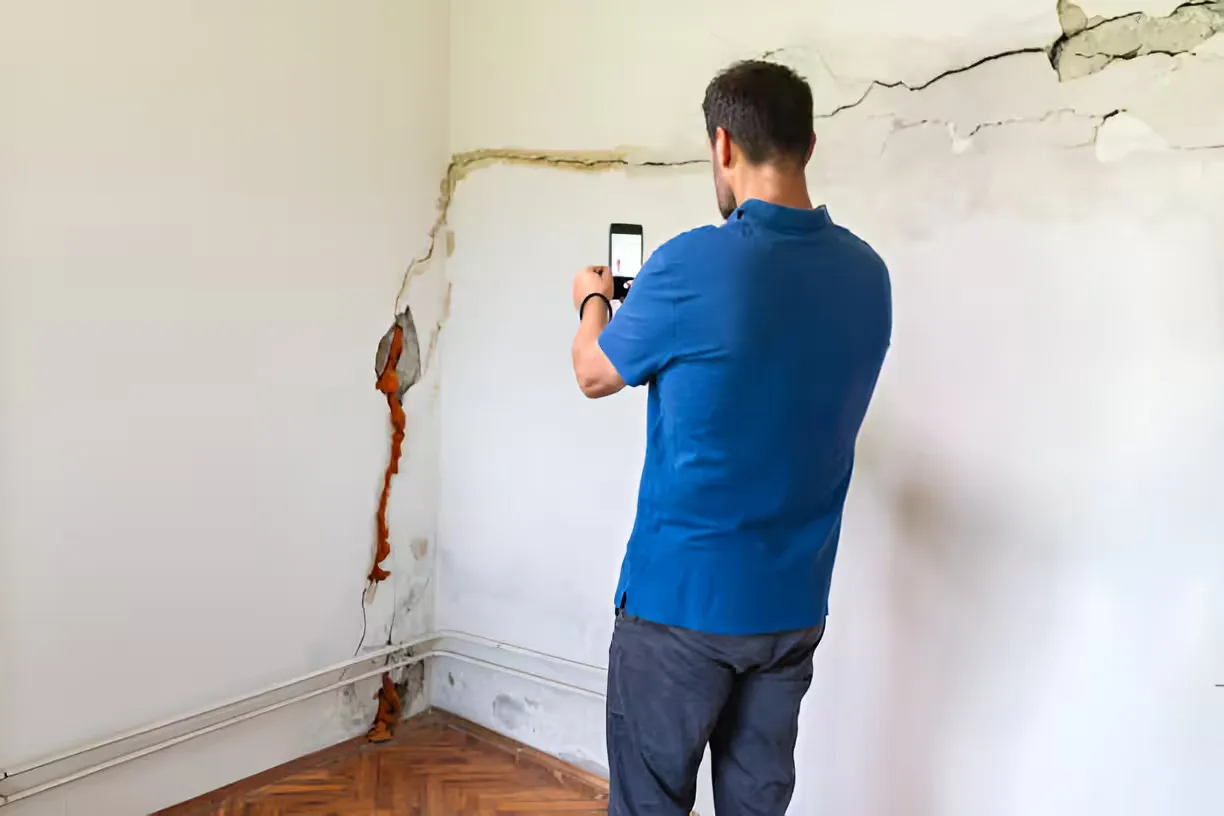
Photograph everything before it moves, including the failure point itself. An adjuster will ask what happened.
Do not use a household vacuum on water, and do not plug anything in near a wet area.
If the ceiling below is stained or sagging, stay out from under it. Water above a ceiling has weight.
We answer the line at any hour and arrive within 60 minutes on a dispatched emergency. If a pipe has gone, call us, and we handle water damage restoration in Charlotte and across the metro.